My site is a small communal outdoor seating area in my student accommodation. It consists of three benches and a shared table, located directly below my apartment window.
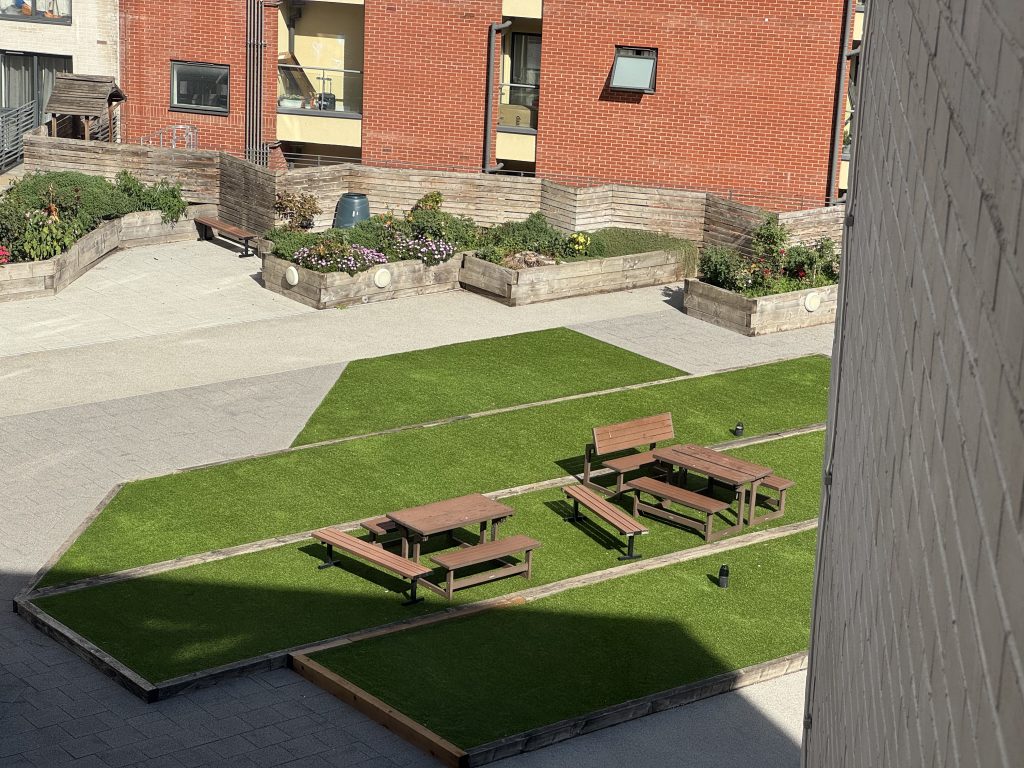
I chose this site because I can observe it repeatedly from my window, while also accessing it directly. This allows me to observe the same space from different distances and at different times.
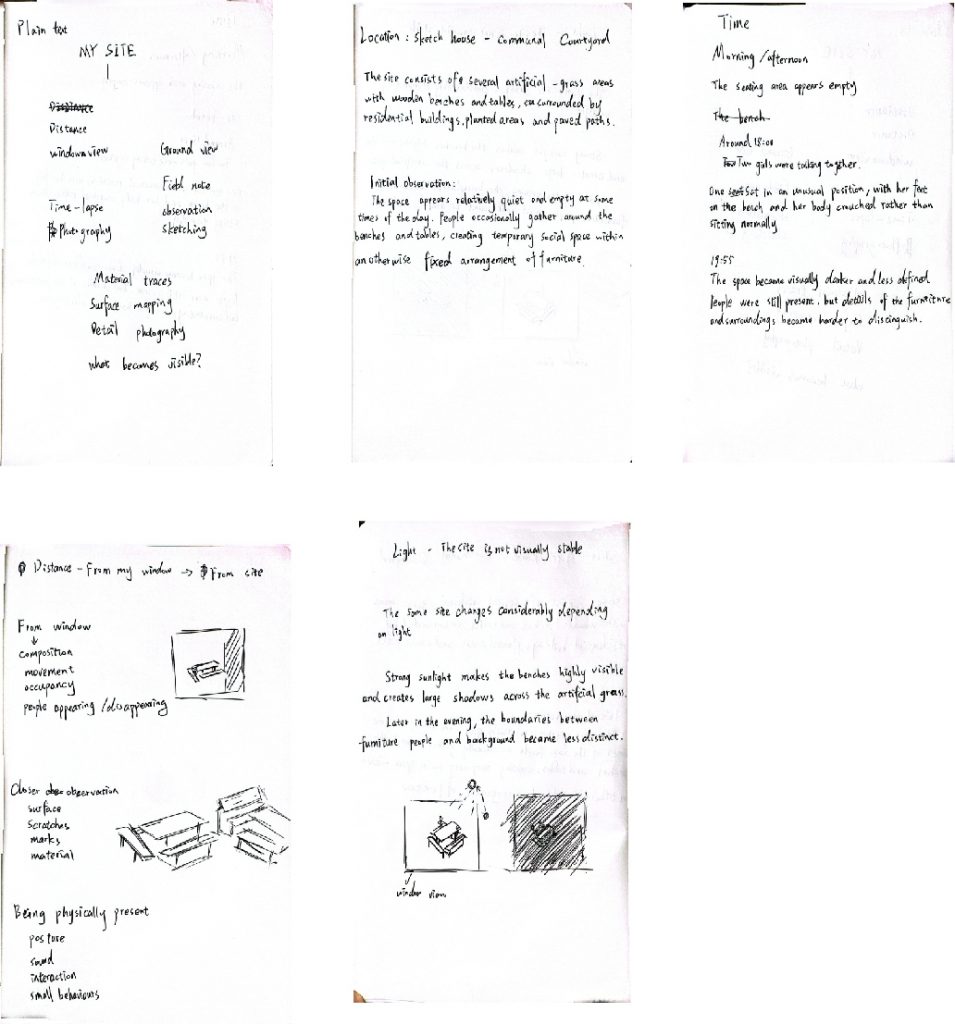
1.Method-NOTE
2.Method-Photography
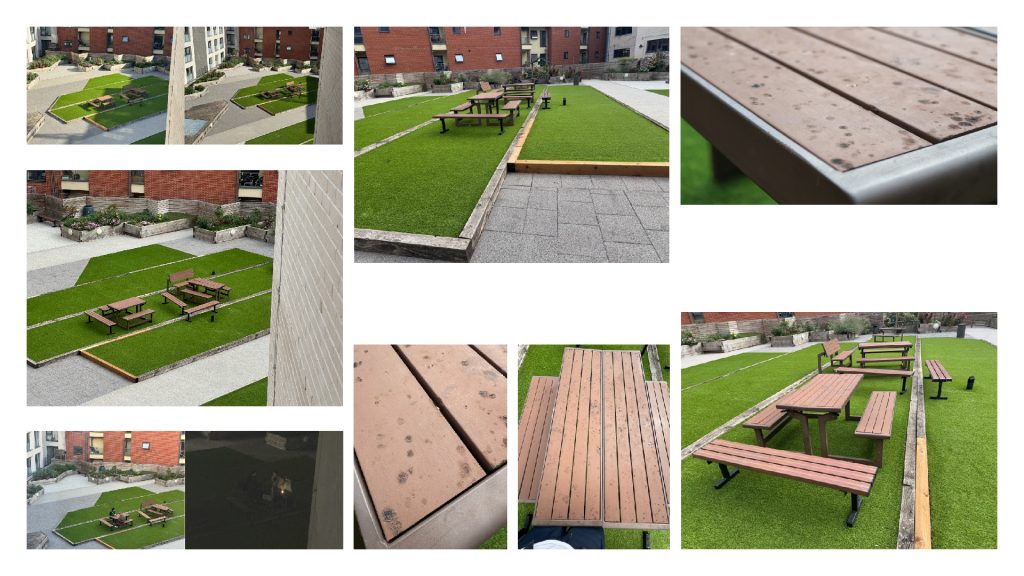
I photographed the site from different distances and at different times, including views from my apartment window and closer observations on site.
What I noticed
From a distance: the site is mainly read through its overall arrangement, movement and occupancy.
At close range: surface details, marks and material changes become visible.
3.Method-Sketching, Mapping
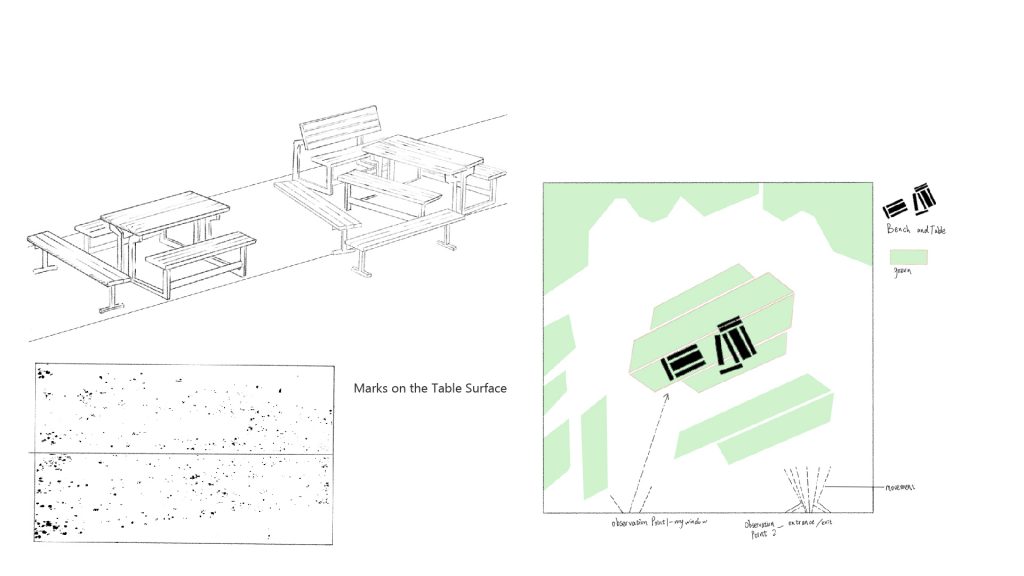
translated the site from photographs and direct observation into drawings and diagrams. Drawing allowed me to focus on the structure of the furniture, while mapping allowed me to record relationships, traces and movement within the site.
The furniture creates a fixed spatial structure, but people’s movement and use of the space are temporary and changeable.
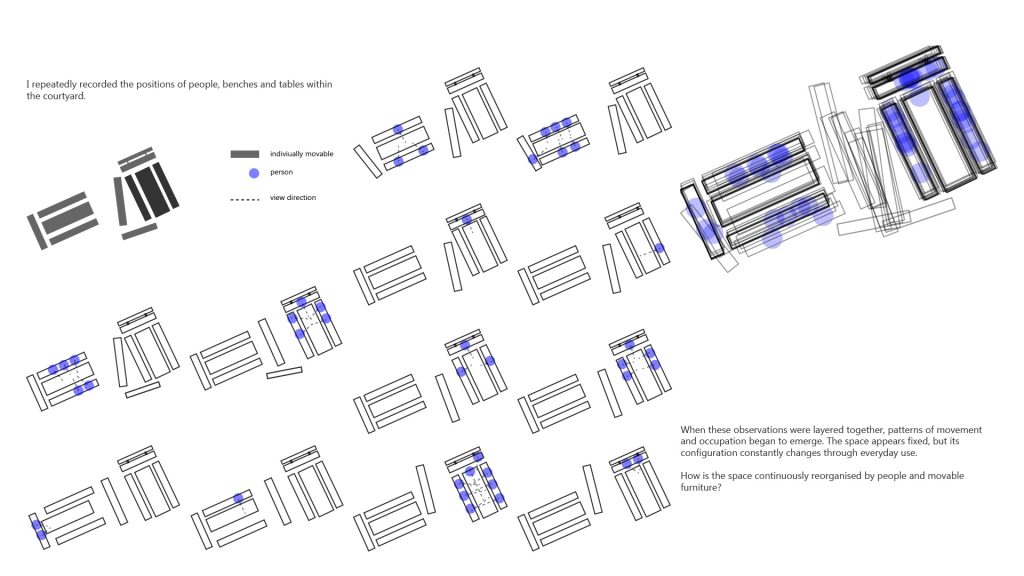
Following the feedback, I documented changes in people’s positions and movements, as well as the repositioning of the benches. By overlaying these records, I made the dynamic traces of activity more visible (top-right image).
Although the marks on the table created a strong visual impact, I realised that they did not contribute meaningfully to my research findings. I therefore decided to exclude them from further observation and focus on the interactions between people and the movement of the benches.
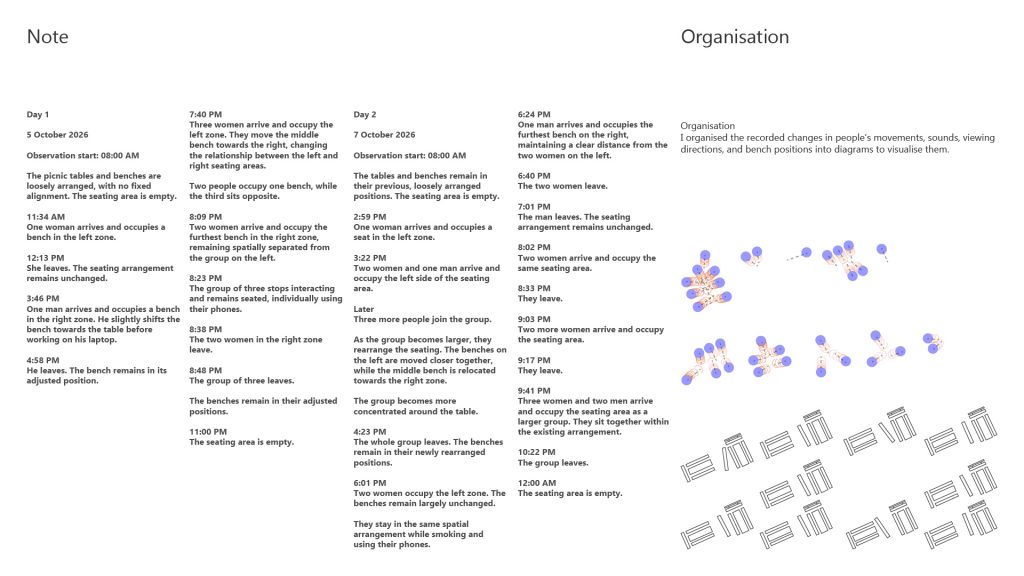
Organisation
Following the feedback, I focused on the relationship between time and spatial change. I recorded people’s activities and movements alongside changes in bench positions, organising the observations into diagrams to reveal patterns of movement and spatial reorganisation.
Through Methods of Investigation, I learned that observation is not simply about collecting information, but about identifying meaningful relationships and translating them into visual forms. I also learned to reconsider which details were relevant to my research and refine my methods accordingly.
Brief
During this project, I chose the communal seating area at Sketch House as my observation site. At first, I was interested in the marks on the table and the general arrangement of the benches. I thought these small details might tell me something about how people used the space. However, as I continued observing, I realised that some visually interesting details did not necessarily help me understand the space better.
The feedback from my tutor and classmates encouraged me to look more closely at the relationship between people and their surroundings. I began to record people’s movements, sitting positions, interactions and the changing positions of the benches at different times. I also compared my observations from two different days and combined the recorded positions into diagrams. This helped me notice that the benches were not always fixed in place. When more people arrived, they sometimes moved the benches closer together to create a shared space. When people came alone, they tended to occupy separate areas.
One of the most interesting things I discovered was that the same space could be used in very different ways throughout the day. Its arrangement was not simply determined by the furniture itself, but also by people’s activities and social relationships. This made me realise that space is more flexible and dynamic than I had initially thought.
Through Methods of Investigation, I learned that observation is not just about collecting as much information as possible. It is also about deciding what is worth observing, questioning my initial assumptions and finding relationships within the information I collect. Feedback helped me change my direction and focus on more meaningful details.
Leave a Reply